Uncontested vs. Non-Adversarial Divorce: Do You Qualify for the 35-Day Split?
Learn the key differences between uncontested and non-adversarial divorce in Connecticut. Find out if you qualify for the expedited 35-day divorce process.
Need help with your divorce? We can help you untangle everything.
Get Started TodayUncontested vs. Non-Adversarial Divorce: Do You Qualify for the 35-Day Split?
When facing divorce in Connecticut, one of the first questions many couples ask is: "How quickly can we get this done?" If you've heard about Connecticut's 35-day divorce option, you're probably wondering whether you qualify. The answer depends on whether your divorce meets the specific criteria for what's called a "non-adversarial" divorce under Connecticut law.
This guide will help you understand the crucial differences between uncontested and non-adversarial divorces, determine whether you qualify for the expedited 35-day process, and navigate the requirements to make your divorce as smooth as possible. We'll walk through the legal requirements, common misconceptions, and practical steps to help you move forward with confidence.
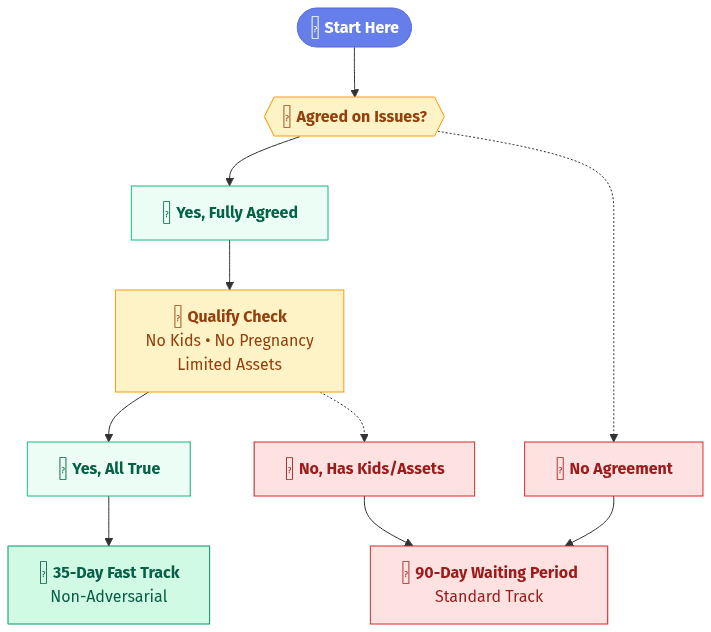
Understanding Connecticut's Two Divorce Tracks
Connecticut offers two distinct paths for divorce proceedings, each with different timelines and requirements:
The Standard Track: 90-Day Waiting Period
Most divorces in Connecticut follow the standard track, which includes a mandatory 90-day "cooling off" period from the date of filing (called the "return date") before the court can finalize your divorce. This applies even if you and your spouse agree on everything.
The Fast Track: 35-Day Non-Adversarial Divorce
For couples who meet specific criteria, Connecticut offers an expedited process that can finalize your divorce in just 35 days from the return date. This accelerated timeline is only available for truly non-adversarial cases.
Connecticut is one of the few states that offers such a short waiting period for qualifying divorces. Most states require waiting periods of 60-180 days minimum, making Connecticut's 35-day option particularly attractive for couples ready to move on.
Uncontested vs. Non-Adversarial: Key Differences
While these terms are often used interchangeably, they have distinct legal meanings in Connecticut:
Uncontested Divorce
An uncontested divorce simply means both spouses agree to get divorced and have resolved all major issues, including:
- Division of property and debts
- Alimony (if applicable)
- Child custody and visitation
- Child support
However, an uncontested divorce still requires the standard 90-day waiting period unless it also qualifies as non-adversarial.
Non-Adversarial Divorce
A non-adversarial divorce is a specific type of uncontested divorce that meets additional criteria allowing for the 35-day expedited process. To qualify as non-adversarial, your divorce must meet ALL of the following requirements:
- Complete Agreement: You must have a signed separation agreement covering all issues
- No Minor Children: You cannot have children under 18 from the marriage
- No Pregnancy: Neither spouse can be pregnant
- Limited Assets: Generally involves straightforward financial situations
- Mutual Consent: Both parties must actively participate in the process
The 35-Day Timeline: How It Actually Works
Understanding the 35-day timeline is crucial for managing expectations:
Day 1: Return Date
The clock starts on your "return date," which is the date you must file your completed divorce papers with the court. This is typically 6-8 weeks after you initially file and serve the divorce complaint.
Days 1-35: Waiting Period
During this time:
- The court reviews your paperwork
- You cannot make changes to your agreement
- Both parties must remain committed to the divorce
Day 36+: Final Hearing
After the 35-day period, the court can schedule your final hearing, where a judge will:
- Review your separation agreement
- Ensure both parties understand the agreement
- Grant the divorce if everything is in order
The 35-day period is the minimum waiting time. Your actual divorce may take longer depending on court scheduling and document processing. Plan for 45-60 days total from your return date to account for realistic timelines.
Do You Qualify? A Step-by-Step Assessment
Let's walk through each requirement to determine if you qualify for the 35-day non-adversarial divorce:
Step 1: Check for Minor Children
Question: Do you have any children under 18 from your marriage?
- If YES: You do NOT qualify for the 35-day process
- If NO: Continue to Step 2
This is a strict requirement with no exceptions. Even if your children are 17 years and 11 months old, you must wait for the standard 90-day period.
Step 2: Confirm No Pregnancy
Question: Is either spouse currently pregnant?
- If YES: You do NOT qualify for the 35-day process
- If NO: Continue to Step 3
This applies regardless of whether the pregnancy is related to the marriage.
Step 3: Evaluate Your Agreement Status
Question: Do you have a written separation agreement that addresses ALL of the following?
- Division of all assets (bank accounts, retirement, real estate)
- Division of all debts (credit cards, loans, mortgages)
- Alimony/spousal support (even if waiving)
- Health insurance coverage post-divorce
- Tax filing status and deductions
If you're missing ANY element: You need to complete your agreement before proceeding.
Step 4: Assess Complexity
Question: Does your case involve any of these complicating factors?
- Business ownership requiring valuation
- Pension division requiring a QDRO
- Disputed property values
- Bankruptcy proceedings
- Restraining orders or protective orders
If YES to any: You likely need the standard 90-day track to resolve these issues properly.
The easiest way to remember: If you have no kids, no pregnancy, and a complete written agreement on everything, you're likely eligible for the 35-day process.
Common Misconceptions About the 35-Day Divorce
Misconception #1: "We agree on everything, so we automatically get 35 days"
Reality: Agreement alone isn't enough. You must meet all the specific criteria, especially the "no minor children" requirement.
Misconception #2: "We can change our agreement during the 35 days"
Reality: Once filed, your agreement is essentially locked. Any changes restart the clock and may disqualify you from the expedited process.
Misconception #3: "35 days means divorced in 35 days total"
Reality: The 35 days start from your return date, which is 6-8 weeks after initial filing. Total time is typically 2.5-3 months.
Misconception #4: "We need lawyers for the 35-day process"
Reality: You can file for a non-adversarial divorce without attorneys, though legal review of your agreement is often wise.
Required Documents for Non-Adversarial Divorce
To file for a 35-day non-adversarial divorce, you'll need:
Core Filing Documents
- Divorce Complaint - Initiates the case
- Summons - Official notice to the other spouse
- Notice of Automatic Orders - Standard protective orders
- Case Management Agreement - Indicates non-adversarial track
Agreement Documents
- Separation Agreement - Your comprehensive agreement
- Financial Affidavits - Sworn statements of income/assets
- Advisement of Rights - Acknowledgment of rights waived
Final Documents
- Dissolution Agreement - Final divorce terms
- Judgment File - Court's official record
Sarah and Tom have been married for 5 years with no children. They own a home together, have separate retirement accounts, and have already divided their belongings. They drafted a separation agreement addressing property division and confirming no alimony. Because they meet all criteria, they can file for a 35-day non-adversarial divorce.
Step-by-Step Guide to Filing Your 35-Day Divorce
Phase 1: Preparation (2-4 weeks before filing)
- Confirm eligibility using the assessment above
- Draft your separation agreement covering all required elements
- Complete financial affidavits with accurate information
- Gather supporting documents (bank statements, property deeds, etc.)
Phase 2: Initial Filing
- File the complaint with your local Superior Court
- Arrange for service of divorce papers on your spouse
- File proof of service with the court
- Note your return date (typically 6-8 weeks out)
Phase 3: Return Date Filing
- Appear in court on the return date (or file documents)
- Submit all agreements and required forms
- File Case Management Agreement indicating non-adversarial
- Begin 35-day waiting period
Phase 4: Final Hearing (Day 36+)
- Attend final hearing (both spouses must appear)
- Answer judge's questions about your agreement
- Receive judgment if approved
- Obtain certified copies for your records
When You Don't Qualify: Making the 90-Day Process Smooth
If you have minor children or don't meet other criteria, you'll follow the standard 90-day track. Here's how to make it as smooth as possible:
Focus on Agreement
Work toward a comprehensive parenting plan and separation agreement during the 90-day period. The more you agree on, the simpler your final hearing.
Use the Time Wisely
- Complete parenting education classes (required with minor children)
- Finalize custody and visitation schedules
- Calculate child support using Connecticut's guidelines
- Address health insurance and childcare costs
Consider Mediation
If you're stuck on certain issues, the 90-day period provides time for mediation to reach agreements without litigation.
While the longer timeline may feel frustrating, the 90-day period for divorces with children serves an important purpose. It ensures adequate time to create thorough parenting plans that serve your children's best interests.
Common Pitfalls to Avoid
Pitfall #1: Incomplete Agreements
Missing even one required element in your separation agreement will delay your case. Common omissions include:
- Health insurance continuation
- Tax exemptions for future years
- Responsibility for joint debts
- Division of household items
Pitfall #2: Unrealistic Timelines
Don't make major life decisions (moving, remarrying) based on the 35-day minimum. Court delays happen, and documents may need revision.
Pitfall #3: Hidden Assets or Debts
Failing to disclose all assets or debts can invalidate your agreement and restart the process—or worse, lead to legal consequences.
Pitfall #4: DIY Legal Documents
While you can self-represent, poorly drafted agreements may be rejected by the court or create future problems.
How Untangle Helps Navigate Both Paths
Whether you qualify for the 35-day process or need to follow the standard 90-day track, having the right support makes all the difference. Here's how Untangle helps:
For 35-Day Eligible Couples
- Document Preparation: We ensure all required forms are completed correctly
- Agreement Review: Our platform helps you create comprehensive separation agreements
- Timeline Management: Clear guidance on each deadline and requirement
- Court Navigation: Step-by-step instructions for filing and appearances
For 90-Day Track Divorces
- Parenting Plans: Tools to create detailed custody and visitation agreements
- Child Support Calculations: Built-in calculators following Connecticut guidelines
- Complex Asset Division: Guidance for retirement accounts, real estate, and businesses
- Progress Tracking: Stay on top of requirements throughout the longer process
Frequently Asked Questions
Can we qualify for 35-day divorce if our children turn 18 during the process?
No. Your children must be 18 or older at the time of filing to qualify for the non-adversarial track.
What if we agree on everything except one small issue?
You must have complete agreement on ALL issues to qualify for the 35-day process. Even one disputed item requires the standard track.
Can we convert from standard to non-adversarial if we reach agreement?
Generally no. Once you've filed on the standard track, you typically cannot convert to the 35-day process.
Do both spouses need to attend the final hearing for a 35-day divorce?
Yes. Both parties must appear at the final hearing for non-adversarial cases to confirm their agreement.
What happens if we change our minds during the 35 days?
Either party can withdraw from the non-adversarial process, but this will require starting over with the standard 90-day timeline.
Making Your Decision: Next Steps
Now that you understand the differences between uncontested and non-adversarial divorces, here are your next steps:
If You Qualify for 35-Day Divorce:
- Draft your separation agreement immediately
- Complete financial affidavits with full disclosure
- File promptly to start the process
- Prepare for final hearing during the waiting period
If You Require the 90-Day Process:
- Focus on reaching agreements on all issues
- Complete required parent education if applicable
- Use the time productively to ensure a smooth divorce
- Consider professional help for complex issues
Regardless of which track you follow, the key to a smooth divorce is preparation, honest communication, and complete documentation. Whether your divorce takes 35 days or 90 days, focusing on these fundamentals will help you move forward successfully.
Summary
Connecticut's two-track divorce system offers flexibility for different situations. The 35-day non-adversarial option provides a quick resolution for couples without minor children who have reached complete agreement. The standard 90-day process ensures adequate time for couples with children or complex issues to create comprehensive agreements.
Understanding which track you qualify for—and preparing accordingly—is crucial for managing expectations and achieving a smooth divorce. Whether you're on the fast track or standard timeline, having the right information and support makes all the difference in successfully navigating your divorce and moving forward with your life.
Remember: the goal isn't just a quick divorce, but a fair and complete resolution that allows both parties to move forward confidently. Take the time to do it right, and you'll avoid complications down the road.
Legal Citations
- • Connecticut Family Law Statutes