Service of Process in Connecticut Divorce: Hiring a Marshal vs. Waiving Service
Learn when to hire a CT state marshal vs. waive service in divorce. Compare costs, timing, and requirements for serving divorce papers in Connecticut.
Need help with your divorce? We can help you untangle everything.
Get Started Today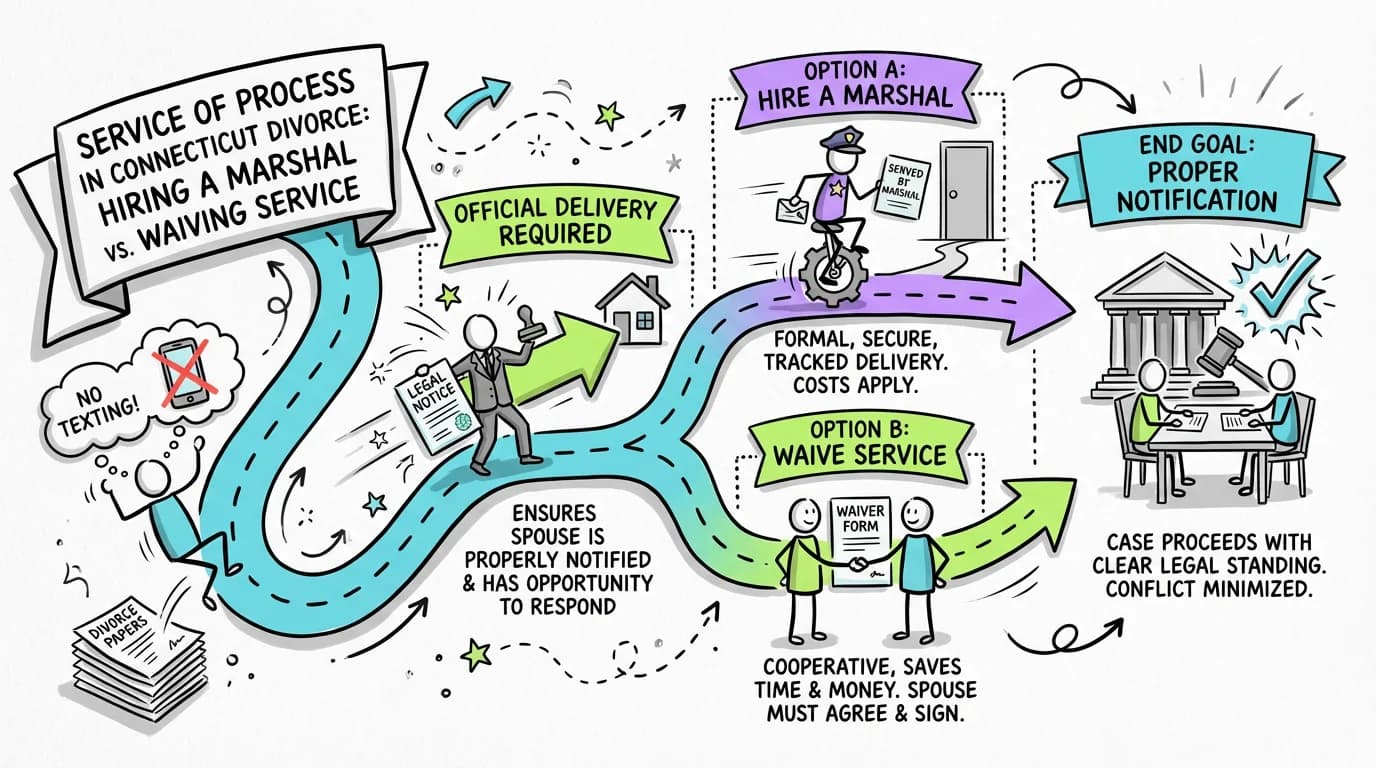
Service of Process in Connecticut Divorce: Hiring a Marshal vs. Waiving Service
When you file for divorce in Connecticut, you can't just send your spouse a text message letting them know. The law requires formal service of process—the official delivery of divorce papers to your spouse—to ensure they're properly notified and have the opportunity to respond. Understanding your options for service of process can save you time, money, and unnecessary conflict.
This guide explains everything you need to know about serving divorce papers in Connecticut, including when to hire a state marshal, when your spouse can waive service, and how to choose the right approach for your situation.
What Is Service of Process and Why Does It Matter?
Service of process is the legal procedure for delivering court documents to the other party in a lawsuit. In divorce cases, this means formally notifying your spouse that you've filed for dissolution of marriage and providing them with copies of all filed documents.
Under Connecticut law, proper service of process is a constitutional requirement. Without it, the court lacks jurisdiction over your spouse, and any judgment entered could be void. In other words, if service isn't done correctly, your entire divorce could be invalidated later—even after you think it's final.
Improper service of process is one of the most common reasons divorces get delayed or dismissed. Courts take this requirement seriously because it protects the fundamental right to notice and an opportunity to be heard.
Connecticut General Statutes § 52-57 governs service of process for civil actions, including divorce. The statute specifies who can serve papers and how service must be accomplished to be legally valid.
Two Main Options for Service of Process
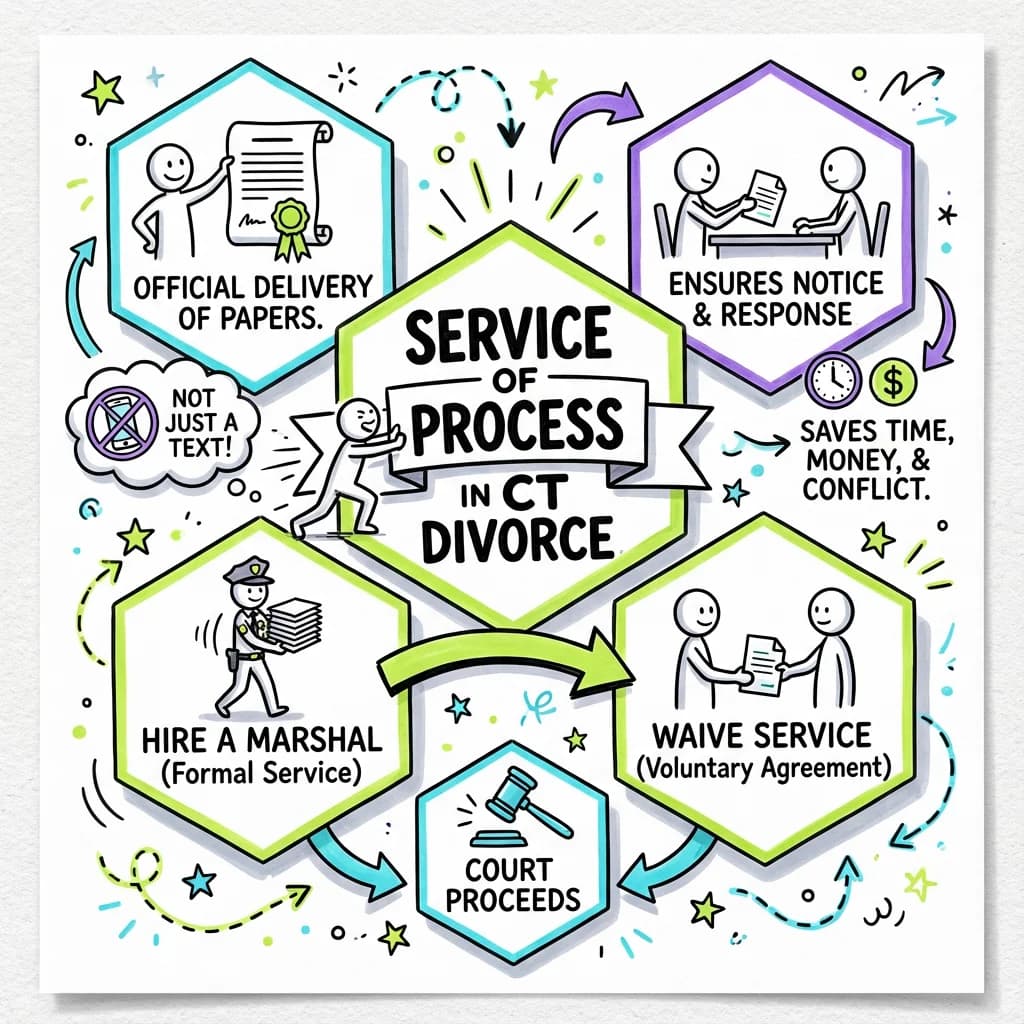
In Connecticut divorces, you have two primary paths for service of process:
- Formal service by a state marshal (or other authorized person)
- Waiver of service (also called "acceptance of service") by your spouse
Let's explore each option in detail.
Option 1: Hiring a State Marshal for Service
What Is a State Marshal?
State marshals are court officers authorized by the State of Connecticut to serve legal documents. They're the most common choice for serving divorce papers and are specifically trained in proper service procedures.
When You Should Use a Marshal
Hiring a state marshal is typically necessary when:
- Your spouse is uncooperative or contentious
- You don't know where your spouse is located
- Your spouse refuses to sign a waiver of service
- You want guaranteed proof of proper service
- Your spouse has been avoiding contact with you
Besides state marshals, Connecticut law allows service by indifferent persons (someone not involved in the case who is at least 18 years old), constables, or sheriffs. However, state marshals are the most commonly used and reliable option.
How Marshal Service Works
Here's what to expect when hiring a state marshal:
Step 1: Prepare Your Documents After filing your divorce complaint with the court, you'll receive court-stamped copies. You'll need to provide the marshal with:
- The original writ, summons, and complaint
- A copy for service on your spouse
- Your spouse's address (home or work)
Step 2: Find and Hire a Marshal Connecticut's state marshals operate independently. You can find one through:
- The Connecticut State Marshal Commission website
- Court clerk recommendations
- Online directories
Most marshals charge between $40-$75 for standard service, though fees may be higher for difficult cases or multiple attempts.
Step 3: The Marshal Serves Your Spouse The marshal will attempt to personally deliver the documents to your spouse. Under Connecticut General Statutes § 52-57, service can be made:
- In-hand service: Delivering papers directly to your spouse
- Abode service: Leaving papers at your spouse's usual place of abode with a person of suitable age and discretion who resides there
Step 4: Receive Proof of Service After completing service, the marshal will provide you with a return of service—a legal document confirming when, where, and how service was accomplished. This document must be filed with the court.
Sarah filed for divorce but her husband Mark was avoiding her calls. She hired a state marshal who attempted service at Mark's apartment twice without success. On the third attempt, the marshal served Mark at his workplace. The return of service documented all attempts and the successful service, which Sarah filed with the court.
What If Your Spouse Can't Be Found?
If your spouse cannot be located despite reasonable efforts, Connecticut law provides for service by publication under Connecticut General Statutes § 52-52. This involves:
- Filing a motion with the court explaining your search efforts
- Obtaining a court order allowing alternative service
- Publishing notice in a newspaper for a specified period
This option is more expensive and time-consuming, so it's best reserved for situations where your spouse truly cannot be found.
Option 2: Waiver of Service (Acceptance of Service)
What Is a Waiver of Service?
A waiver of service (sometimes called an acceptance of service) is a document your spouse signs acknowledging they've received copies of the divorce papers. By signing, they voluntarily give up their right to formal service by a marshal.
When Waiver of Service Makes Sense
Waiving service is ideal when:
- You and your spouse are communicating
- Your divorce is amicable or uncontested
- You want to save money on marshal fees
- You want to expedite the process
- Your spouse is cooperative and willing to participate
Waiving service can save $40-$75+ in marshal fees—money better spent elsewhere in your divorce. For couples working together toward an amicable resolution, this is often the smarter choice.
How the Waiver Process Works
Step 1: Your Spouse Receives the Documents You can mail, email, or hand-deliver copies of all divorce papers to your spouse. However, you cannot personally serve them—if service isn't waived, a neutral third party must do it.
Step 2: Your Spouse Reviews the Papers Give your spouse adequate time to review the documents. Rushing them could create problems later if they claim they didn't understand what they were signing.
Step 3: Your Spouse Signs the Waiver The waiver form must be signed and typically notarized. The document states that your spouse:
- Received copies of all divorce papers
- Voluntarily waives formal service
- Understands the legal proceedings have begun
Step 4: File the Signed Waiver Once signed, file the waiver of service with the court. This becomes your proof that your spouse was properly notified.
Important Considerations for Waivers
Your spouse cannot be coerced or pressured into signing a waiver. If they later claim they were forced to sign, it could invalidate service and delay your divorce. Make sure your spouse genuinely understands and agrees.
A few more things to keep in mind:
- Timing matters: The waiver should be signed after you've filed your divorce papers, not before
- All documents included: Your spouse must receive copies of everything filed with the court
- No hidden surprises: Don't add documents after getting the waiver signed
Comparing Your Options: Marshal vs. Waiver
| Factor | State Marshal | Waiver of Service |
|---|---|---|
| Cost | $40-$75+ | Free |
| Speed | 1-2 weeks typically | Immediate once signed |
| Cooperation needed | None | Full cooperation required |
| Proof of service | Marshal's return | Signed waiver document |
| Best for | Contested divorces, uncooperative spouses | Amicable, uncontested divorces |
| Risk level | Very low (professional handling) | Low if done properly |
Step-by-Step Guide: Choosing Your Approach
Not sure which option is right for you? Follow this decision tree:
Step 1: Assess Your Relationship Dynamic
- Is your spouse cooperative and responsive? → Consider waiver
- Is your spouse avoiding you or hostile? → Use a marshal
- Are you uncertain? → Start with waiver request, have marshal as backup
Step 2: Communicate with Your Spouse
If you're considering a waiver, have a direct conversation:
- Explain that you've filed for divorce
- Let them know they'll receive papers to review
- Ask if they're willing to sign a waiver of service
- Give them time to consider (don't pressure)
Step 3: Prepare the Appropriate Documents
For marshal service: Gather filed documents and spouse's address For waiver: Prepare copies of all filed documents plus the waiver form
Step 4: Execute Your Plan
- If using a marshal: Hire one, provide documents, and wait for the return of service
- If using a waiver: Deliver documents, have spouse sign waiver, file with court
Step 5: Confirm Proper Filing
Regardless of method, ensure your proof of service (return or waiver) is filed with the court. Your case cannot proceed without it.
Common Mistakes to Avoid
Mistake 1: Serving Papers Yourself
You cannot personally serve your spouse. Even if you're on good terms, handing them papers yourself doesn't constitute valid service. Either use a marshal or have them sign a proper waiver.
Mistake 2: Assuming Verbal Agreement Is Enough
"My spouse said they got the papers" isn't proof of service. You need documented evidence—either a marshal's return or a signed waiver.
Mistake 3: Incomplete Document Delivery
Service must include all filed documents, not just the divorce complaint. Missing documents can invalidate service and cause delays.
Mistake 4: Forging or Coercing a Signature
This should go without saying, but never forge your spouse's signature on a waiver or pressure them into signing. This is fraud and can result in serious legal consequences.
Mistake 5: Waiting Too Long
Connecticut Practice Book Rule 10-15 requires that the return of service be filed with the court before the return date specified in the summons. Missing this deadline can cause your case to be dismissed.
The return date is not a court appearance date—it's the deadline by which your spouse's response is due. Make sure service is completed well before this date to give your spouse adequate time to respond.
What Happens After Service?
Once service is complete and filed with the court:
- The clock starts: Your spouse typically has until the return date to file an appearance
- 90-day waiting period begins: Connecticut requires a 90-day "cooling off" period before a divorce can be finalized (C.G.S. § 46b-67)
- Your spouse can respond: They may file an appearance, answer, or cross-complaint
- Negotiations can begin: Discovery, mediation, and settlement discussions can proceed
If your spouse doesn't respond after proper service, you may be able to obtain a default judgment—but the court will scrutinize your proof of service carefully before entering any judgment.
How Untangle Can Help
Navigating service of process is just one of many procedural hurdles in a Connecticut divorce. At Untangle, we help you understand each step of the process and provide the documents you need.
Our platform can help you:
- Prepare proper divorce documents ready for filing
- Understand your service options based on your situation
- Generate waiver of service forms when appropriate
- Track important deadlines so you don't miss filing requirements
- Save money compared to hiring an attorney for routine procedures
Whether you're pursuing an amicable divorce where waiver makes sense, or a more complex situation requiring marshal service, Untangle provides the guidance you need to move forward confidently.
Frequently Asked Questions
Can my spouse refuse to accept service?
Your spouse can refuse to sign a waiver of service, but they cannot refuse service from a state marshal. If they try to avoid the marshal, the marshal can document attempts and potentially use abode service.
How long does marshal service take?
Typically 1-2 weeks, though it depends on the marshal's availability and whether your spouse is easy to locate. Difficult cases may take longer.
What if my spouse lives out of state?
Out-of-state service is possible but more complex. Connecticut recognizes service made in accordance with the destination state's laws. You may need a marshal or process server in that state.
Can I serve divorce papers by email or text?
No. Connecticut law does not currently allow electronic service for initiating a divorce. Your spouse must either be formally served or sign a waiver.
Do I need a lawyer for service of process?
No. Many people handle service of process themselves. However, if your situation is complex—such as a spouse who's hiding or residing abroad—legal guidance may be helpful.
Summary and Next Steps
Service of process ensures your divorce begins on solid legal footing. Your two main options are:
- Hire a state marshal for guaranteed, professional service ($40-$75+)
- Have your spouse sign a waiver for free, cooperative service
Your action items:
- Assess whether your spouse will cooperate with a waiver
- If using a marshal, locate one and prepare your documents
- If using a waiver, prepare all documents and the waiver form
- Ensure proof of service is filed with the court before the return date
- Keep copies of all service documents for your records
Starting your divorce right means getting service of process done correctly. Take the time to choose the appropriate method for your situation, and you'll be on your way to moving forward with the next phase of your life.
Legal Citations
- • C.G.S. § 46b-67 (Time Frame for Court to Proceed) View Source
- • C.G.S. § 52-52 (Service by Publication) View Source
- • C.G.S. § 52-57 (Service of Process) View Source
Related Articles
Connecticut Divorce Filing Requirements
Learn about residency requirements and what documents you need before serving papers.
How Long Does a Divorce Take in Connecticut?
Once service is complete, learn about Connecticut's mandatory 90-day waiting period.
What is an Uncontested Divorce in Connecticut?
Your service method often depends on whether your divorce is cooperative or contested.