How Much Does Divorce Cost in Connecticut? Complete Cost Breakdown
Learn the true cost of divorce in Connecticut, from court filing fees to attorney costs. Discover how to minimize expenses with DIY options and uncontested divorce.
Need help with your divorce? We can help you untangle everything.
Get Started Today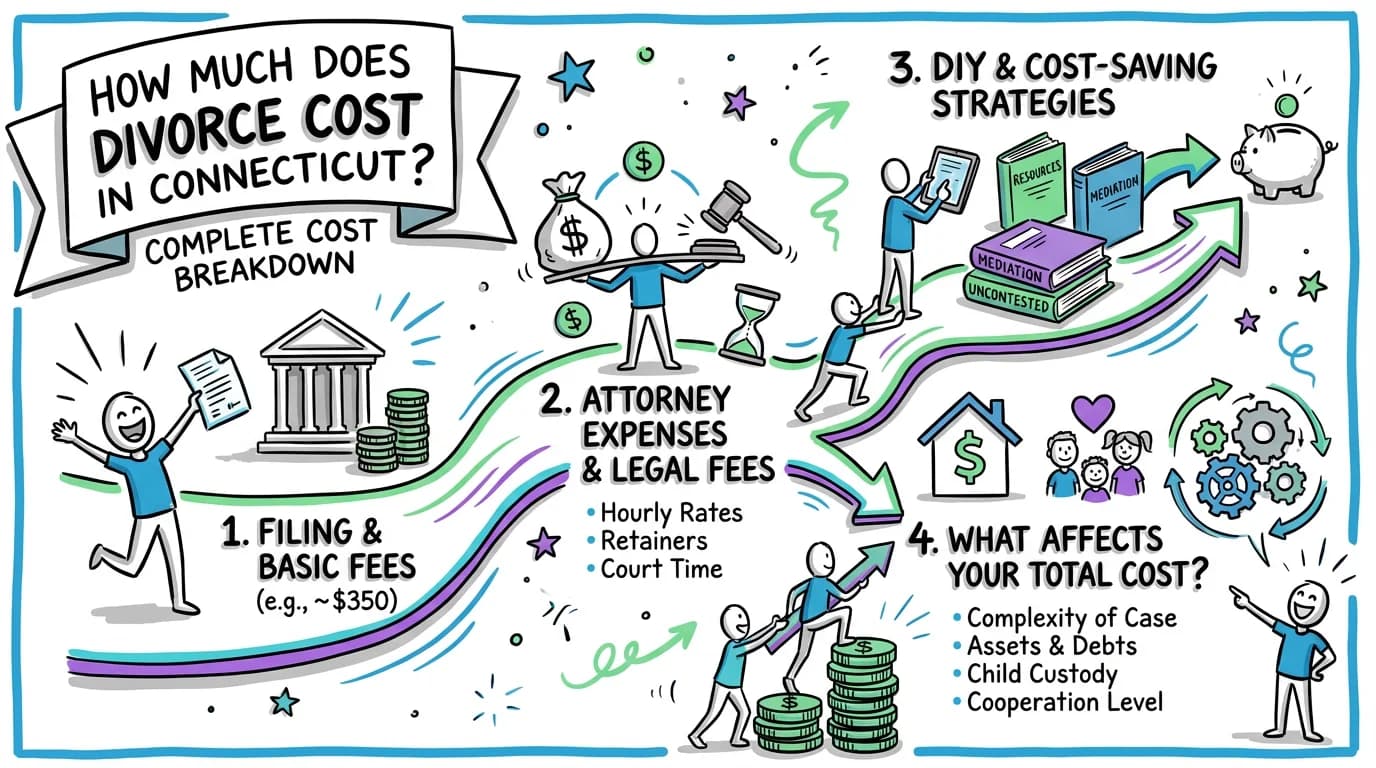
How Much Does Divorce Cost in Connecticut? Complete Cost Breakdown
A divorce in Connecticut can cost anywhere from $350 to $50,000 or more, depending on the path you choose. The minimum cost is the court filing fee of approximately $350, which applies even if you handle everything yourself. An uncontested divorce where both spouses agree on all terms typically costs $350-$1,500 if done without attorneys, while a contested divorce with lawyers can easily run $15,000-$50,000+ per spouse. The good news for budget-conscious individuals: Connecticut law specifically allows for nonadversarial dissolution, making affordable DIY divorce a real possibility.
Understanding Connecticut Divorce Costs: The Big Picture
The total cost of your Connecticut divorce depends primarily on one factor: how much you and your spouse agree on. When couples can work together to resolve issues like property division, child custody, and support, they unlock the most affordable path—the nonadversarial dissolution process established under C.G.S. § 46b-44a. This streamlined approach requires both parties to file a joint petition attesting that they've already reached agreement on all issues, eliminating the need for costly litigation.
Beyond agreement levels, costs are driven by complexity. A divorce involving a family home, retirement accounts, business interests, and custody disputes will naturally cost more than a short marriage with minimal assets and no children. Each contested issue requires time—whether that's your time researching and preparing documents, a mediator's time helping you negotiate, or attorneys' billable hours arguing in court.
The Connecticut court system has also established programs to help reduce costs. Under C.G.S. § 46b-53a, mediation services may be available in certain judicial districts to help couples resolve property, financial, custody, and visitation issues outside of court. These services can dramatically reduce expenses compared to traditional litigation, making them worth exploring regardless of your budget.
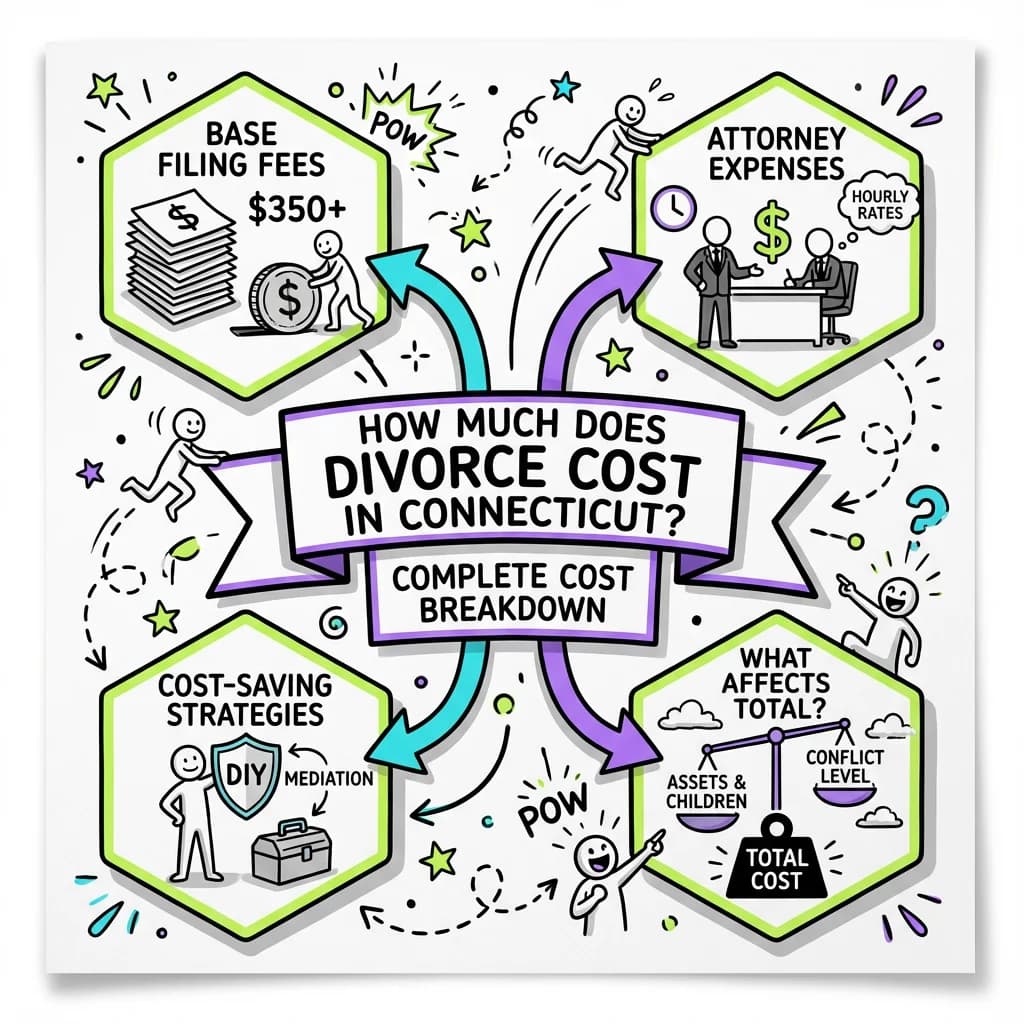
Breakdown of Connecticut Divorce Filing Fees
| Cost Category | Amount | Notes |
|---|---|---|
| Court Filing Fee | ~$350 | Required for all divorces |
| Certified Copy Fee | $25-50 | For official divorce decree copies |
| Sheriff/Marshal Service | $50-100 | Only needed for contested cases |
| Parenting Education Program | $100-150 | Required if minor children |
| Certified Mailing | $10-20 | For various court notifications |
| Total Minimum (No Attorney) | $350-500 | Uncontested, no children |
| Total Minimum (With Children) | $450-650 | Uncontested, includes parenting class |
The court filing fee is unavoidable—it's the price of admission to Connecticut's family court system. However, if you're experiencing financial hardship, you may qualify for a fee waiver. The court will review your income and expenses to determine eligibility, so don't let filing fees alone prevent you from pursuing divorce if you're truly struggling financially.
Keep in mind that these are just the direct court costs. Additional expenses can include document preparation services, notarization fees for your joint petition (required under C.G.S. § 46b-44a), and the time you'll spend gathering financial records. Tools like Untangle's document generation features can help you organize everything you need without paying attorney rates for basic paperwork.
The True Cost of Attorney Fees in CT Divorces
Attorney fees represent the largest expense in most Connecticut divorces. Hourly rates for CT divorce attorneys typically range from $250-$500 per hour, with experienced family law specialists in Fairfield County and other affluent areas charging $500-$750 or more. Even a "simple" contested divorce can require 30-60 attorney hours per side, quickly pushing costs into five figures.
Connecticut law under C.G.S. § 46b-62 allows the court to order one spouse to pay the other's reasonable attorney fees based on their respective financial abilities. This means if there's a significant income disparity, the higher-earning spouse may be ordered to contribute to the other's legal costs. However, this doesn't guarantee coverage—courts consider multiple factors and may only award partial fees.
For budget-conscious individuals, limited-scope representation offers a middle ground. Instead of hiring an attorney for full representation, you can pay for specific services like document review, court appearance coaching, or help with particularly complex issues. This "unbundled" approach lets you handle the bulk of the work yourself while getting professional guidance on critical matters.
Hidden Attorney Costs to Watch For
Beyond hourly fees, be aware of these additional charges that can inflate your legal bills:
- Retainer fees: Most attorneys require $2,500-$10,000 upfront
- Paralegal fees: Often billed at $100-200/hour for "support" work
- Communication charges: Some bill for every email and phone call
- Court appearance minimums: Many charge 2-4 hour minimums per appearance
- Expert consultations: Accountants, appraisers, custody evaluators add up fast
The DIY Divorce Path: Nonadversarial Dissolution
Connecticut's nonadversarial dissolution process under C.G.S. § 46b-44a offers the most affordable path for couples who can work together. To qualify, you and your spouse must attest under oath that you've resolved all issues regarding property division, alimony, and (if applicable) child custody, visitation, and support. You'll file a joint petition together rather than one spouse serving the other.
This process eliminates many costs associated with contested divorce. There's no need to pay a sheriff for service of process. You won't have prolonged discovery disputes requiring attorney involvement. The court process is streamlined because you're presenting an agreed-upon plan rather than asking a judge to decide contested issues.
However, "DIY" doesn't mean "without preparation." You'll still need to complete all required forms correctly, including the Divorce Complaint (Form JD-FM-159), Financial Affidavit (Form JD-FM-006), and other supporting documents. Connecticut Practice Book Rule § 25-30 requires sworn financial statements showing current income, expenses, assets, and liabilities at least five business days before any hearing. Using Untangle's guided questionnaire can help ensure you gather all necessary financial information and don't miss required disclosures that could jeopardize your agreement.
What You Need for a DIY Divorce in Connecticut
To successfully navigate an uncontested divorce yourself, you'll need:
- Complete agreement with your spouse on ALL issues
- Ability to gather and organize financial records
- Patience to learn court procedures and requirements
- Time to prepare, file, and follow up on documents
- Willingness to attend required hearings and programs
The nonadversarial process also comes with an important safety valve: under C.G.S. § 46b-44b, either party can revoke the joint petition at any time before the court enters a final decree simply by filing a notice of revocation. This means you're not locked into an agreement if circumstances change or you realize the terms don't work for you.
Mediation: A Cost-Effective Middle Ground
For couples who agree on most issues but need help with specific sticking points, mediation offers significant savings over litigation. Connecticut's court-sponsored mediation program under C.G.S. § 46b-53a provides services addressing property, financial, custody, and visitation issues in designated judicial districts.
Private mediators typically charge $200-$400 per hour, with sessions lasting 1-3 hours. Most couples resolve their issues in 3-8 sessions, making the total mediation cost roughly $1,000-$5,000—a fraction of what two attorneys would charge to litigate the same issues. Plus, all communications during mediation are privileged under the statute, meaning nothing said can be used against you if mediation fails and you end up in court.
The key advantage of mediation is control. Rather than having a judge make decisions about your family's future, you and your spouse work together to create solutions that work for both of you. This collaborative approach often leads to better compliance with agreements and reduced post-divorce conflict—savings that extend far beyond the immediate financial costs.
Connecticut Divorce Cost Comparison
| Divorce Type | Typical Cost Range | Timeline | Best For |
|---|---|---|---|
| DIY Uncontested (No Kids) | $350-$750 | 3-4 months | Short marriages, minimal assets, full agreement |
| DIY Uncontested (With Kids) | $500-$1,000 | 3-5 months | Cooperative parents, agreed custody/support |
| Mediated Divorce | $1,500-$6,000 | 4-8 months | Most issues agreed, need help on specifics |
| Collaborative Divorce | $5,000-$15,000 | 6-12 months | Complex assets, committed to avoiding court |
| Attorney-Negotiated | $10,000-$25,000 | 6-18 months | Significant disagreements, moderate complexity |
| Fully Litigated | $25,000-$100,000+ | 12-36 months | High conflict, complex assets, custody battles |
These ranges represent costs per spouse—meaning a fully litigated divorce could cost the couple $50,000-$200,000 or more combined. When you see those numbers, the value of reaching agreement becomes crystal clear. It is critical to compare the potential legal fees against the value of the assets in dispute; spending $20,000 to secure an extra $5,000 in assets is a financial loss, despite the "win" in court.
Step-by-Step: Minimizing Your Connecticut Divorce Costs
-
Start with honest self-assessment: Can you and your spouse communicate productively? If yes, DIY or mediation is realistic. If every conversation becomes a fight, budget for professional help.
-
Gather financial documents early: Bank statements, tax returns, retirement account statements, mortgage documents, vehicle titles, credit card statements. Having everything organized saves time (and money if you do hire help). Untangle's financial organization tools can help you compile everything in one place.
-
Use the correct financial affidavit form: Connecticut requires Form JD-FM-006 for all divorces. If neither party earns over $75,000 annually and total assets are under $75,000, you can use the Short Form version, which is simpler to complete.
-
Understand the Pathways system: Connecticut Practice Book Rule § 25-50A establishes case management "tracks" based on complexity. Track A cases (minimal court involvement) move fastest and cheapest. Demonstrating agreement and organization at your initial Resolution Plan meeting can help ensure you're placed on an appropriate track.
-
Complete parenting education if required: If you have minor children, both parents must complete an approved parenting education program. Budget $100-$150 per person and complete this early—it's required before your divorce can be finalized.
-
Consider limited attorney consultation: Even DIY filers can benefit from a one-time consultation ($200-$500) to review their agreement and ensure they haven't overlooked important issues. This small investment can prevent costly mistakes.
-
File correctly the first time: Rejected filings mean delays and potentially additional fees. Use Untangle's document review checklist to verify completeness before submitting to the court.
Additional Costs to Budget For
Beyond direct divorce expenses, consider these often-overlooked costs:
- New housing deposits: First/last month rent plus security deposit
- Utility setup fees: Transferring or establishing new accounts
- Insurance changes: Separate auto, health, and renter's/homeowner's policies
- Vehicle title transfers: If dividing cars
- Refinancing costs: If one spouse keeps the home and must refinance
- QDRO preparation: $300-$1,500 for retirement account division orders
- Tax preparation: More complex returns during/after divorce year
Planning for these expenses alongside your divorce budget prevents unpleasant surprises and helps you emerge financially stable.
When DIY Isn't Enough: Signs You Need Professional Help
While DIY divorce can work beautifully for the right situations, certain circumstances call for professional assistance:
- Domestic violence or abuse: Your safety comes first. Seek attorney help immediately.
- Hidden assets: If you suspect your spouse is concealing income or property, you need discovery tools only available through formal legal processes.
- Business ownership: Valuing and dividing business interests requires expertise.
- Complex retirement accounts: Pensions, stock options, and deferred compensation need careful handling.
- Significant debt disputes: Who's responsible for which debts can have lasting consequences.
- High-conflict custody situations: When children's wellbeing is at stake, professional guidance protects them.
- Power imbalances: If one spouse controlled all finances or decision-making, independent advice levels the field.
Under C.G.S. § 46b-62, if your spouse hires an attorney and you can't afford one, the court may order your spouse to contribute to your legal fees. Don't let cost alone force you into an unfair agreement—explore all options including fee-shifting, legal aid, and limited-scope representation.
Getting Started on Your Budget-Friendly Divorce
The path to an affordable Connecticut divorce starts with understanding your options and organizing your information. Whether you pursue a fully DIY approach using Untangle's task dashboard to stay organized, work with a mediator, or hire an attorney for limited assistance, preparation is key to controlling costs.
Remember that the Connecticut court system is designed to accommodate self-represented parties. The nonadversarial dissolution process exists specifically to help cooperative couples divorce efficiently and affordably. With the right preparation and realistic expectations, you can navigate this process without breaking the bank.
Take time to honestly assess your situation: Do you and your spouse agree on the major issues? Can you communicate well enough to negotiate remaining details? If yes, a DIY or mediated divorce could save you tens of thousands of dollars while giving you more control over the outcome. If not, early investment in professional help often costs less than prolonged conflict down the road.
Frequently Asked Questions
What are the average attorney fees for divorce in Connecticut?
Attorney fees for divorce in Connecticut typically range from $15,000 to $50,000+ per spouse for contested cases, though uncontested divorces with limited legal help can cost significantly less.
What is the difference in cost between contested and uncontested divorce in CT?
An uncontested divorce in Connecticut costs $350-$1,500 when handled without attorneys, while a contested divorce with lawyers typically runs $15,000-$50,000+ per spouse due to increased legal fees and court time.
How can I afford a divorce in Connecticut on a limited budget?
Connecticut allows nonadversarial dissolution under C.G.S. § 46b-44a, which lets couples who agree on all terms file jointly for just the $350 court filing fee, and mediation services may be available in certain judicial districts to reduce costs.
What hidden costs should I budget for in a Connecticut divorce?
Beyond filing fees and attorney costs, budget for expenses like property appraisals, business valuations, retirement account division fees (QDROs), mediator fees, and potential costs for child custody evaluations if disputes arise.
How much is the court filing fee to file for divorce in Connecticut?
The court filing fee for divorce in Connecticut is approximately $350, which is the minimum cost you'll pay even if you handle the entire process yourself without an attorney.
Legal Citations
- • C.G.S. § 46b-44a (Nonadversarial Dissolution of Marriage) View Source
- • C.G.S. § 46b-44b (Revocation of Joint Petition) View Source
- • C.G.S. § 46b-53a (Mediation Program for Dissolution) View Source
- • C.G.S. § 46b-62 (Attorney's Fees Orders) View Source
- • CT Practice Book Rule § 25-30 (Financial Statements) View Source
- • CT Practice Book Rule § 25-50A (Pathways Case Management) View Source
- • Form JD-FM-006 (Financial Affidavit Short Form) View Source
- • Form JD-FM-159 (Divorce Complaint) View Source